Tuesday, May 31, 2011

Signs of summer

Memorial Day is always heralded as the official start of summer, even though the calendar says otherwise.

Balloons start popping up at the end of driveways, marking the location of graduation parties. Church parking lots start to fill up on Saturdays for the summer wedding season.

It's also the time of year when farms all around the state open their doors for Breakfasts on the Farm. Here in Stearns County, our Breakfast on the Farm will be held next Saturday, June 4th at Schefers Dairy near St. Stephen.

For me, I know summer is officially here when the discbine starts laying out swaths of alfalfa and orchard grass. We're going to try making haylage with our first crop. Keep your fingers crossed for us.


Along with the smell of fresh cut hay, there are some other tell-tale signs of summer:

• The kitchen floor could almost pass as the barn floor since nobody thinks they're going to be inside long enough to warrant removing their shoes and nobody wants to stay inside long enough to sweep the floor.

• Despite the sunscreen, Dan and Monika are developing farmers' tans from all of their hours "working" outside. But it's hard to tell what's tan and what's dirt until you hose them off in the shower.


• I have a list of ideas to write about that's two pages long, but I don't want to stay in the house any more than the kids do, so the items on the list keep increasing faster than I can check them off. Ditto for the photos to share.

• Heat and humidity. We had our first pressure cooker of a day yesterday. As we were sitting in the grass under a tree, Dan asked simply, "Why is it so hot?" (I'm not sure, since I had to put long underwear on again last Friday.)

• The bugs are back. First the June beetles started showing up in the sandbox. This morning there was something buzzing around my head while I brought the cows in. Dan even had his first wood tick of the year.


Without a doubt, summer is here. I hope your summer has plenty of sunshine, dirt and bugs (not the biting ones, though).

Friday, May 27, 2011

Bovine waterbirth?

I won't say that it would be boring, but dairy farming would be a lot less eventful without the pasture.

When I brought cows in yesterday morning, Laugh wasn't with the herd. So I walked back out to look for her.

I found her on the bank of the back pond, just standing there and shifting her weight the way cows do when they're in early labor.

The back pond. (This isn't Laugh, but it's the only photo I have of that pond...)

She ambled away when I got a little closer, so I left her there to labor in peace.

When Glen asked where Laugh was after I got back to the barn, I jokingly told him she was out by the back pond planning her waterbirth.

He only half laughed.

During our first summer here, he ended up waist-deep in one of the ponds trying to prevent a bovine waterbirth. The calf's feet and nose were out and the cow was just standing in the pond like she had every intention of delivering the calf right there.

I offered to go check on Laugh an hour later, but Glen said he could do it a when he went over to the neighbor's to feed the heifers.

After he'd been gone for awhile, my phone rang.

"Was Laugh actually IN the pond when you checked on her this morning?"

"No, she was just hanging out on the east bank."

"Well, she's in the pond now! Can you open the gate to the waterway? I'm going to bring her up to the barn." (We're using our grassed waterway as a calving pen for the summer.)

Not more than a couple minutes passed before my phone rang again.

"You're not going to believe this…" Glen started.

He said that when he got up to the pond to chase Laugh out, her calf was standing right next to her, up to its ears in the water. From a distance he hadn't been able to see the calf at all because its black head was camouflaged by Laugh's shadow.

He grabbed onto the calf and pulled it out of the water. Since he didn't dare leave it on the bank, he carried it all the way back to where he had parked the truck.

At least the calf was dry by the time they got home.

We're not sure if Laugh delivered the calf in the water or if it rolled down the bank and ended up in the pond. Hardly enough time had passed for the calf to be delivered, get up by itself and walk into the pond. (Enough time had passed, though, for a leech to find its umbilical cord. Eew.)

Regardless of how it happened, we're just glad the calf is alive. We named her Lilypad. Her sire is one of Glen's favorite bulls, so he said he would have been more than a little upset if things hadn't turned out okay.

Hopefully, the rest of the summer's deliveries are a little less remarkable.

Saturday, May 14, 2011

Green knees

We finally got the cows out to pasture on Wednesday — a full two weeks later than last year. The event has become something of a holiday around here. It means that summer is finally on its way and the cows are finally out of the barn. Life seems so much simpler when the cows are on grass.

However… putting the cows out to pasture means we're once again switching cows. But I'll take switching cows over the alternative, which is selling the extras.


Last night while we were feeding cows in the barn, I noticed something that brought a smile to my face. The cows all had green knees!

The grass is so lush right now, that when the cows lay down, their knees get grass stained, just like Dan's pants this time of year.


But I won't be watching their green knees for much longer. Since we were able to find some used J-bunks last fall, we'll have enough bunk space in the cow yard to feed all of the cows outside. That means, pretty soon, we'll be done forking and carting feed until we close the pasture gate this fall. Woo-hoo!

Friday, April 29, 2011

Lost and found

Like every farm family, we lose things. We look around for awhile in hopes of finding the lost items. When they don't turn up, we write them off as lost forever.

The objects most likely to disappear around here are sippy cups. The kids bring them out to the barn and they never make it back to the house. A couple of sippy cups, we later discovered, were snatched by Skippy and devoured. But the others seem to have simply vanished into thin air.

So it brought us a good chuckle this week when one of the lost sippy cups was found — in the manure pit.

We emptied the manure pit onto our fields this week and as the last of the manure was pumped out, one of the pumping crew members pointed out a small purple object floating in the corner of the pit.

Glen crawled down the pit wall, retrieved the completely undamaged sippy cup, and crawled back up laughing.

The crew member, laughing with him, said, "I wouldn't drink that!"

Glen thought maybe we could clean the cup up and put it back in the rotation, but I thought otherwise. The sippy cup went into dumpster.

At least I know now what became of it.

The sippy cup wasn't the only thing that turned up in the pit this spring. The small red gas jug that we keep in the back of the barn for the straw chopper, which had mysteriously disappeared this winter, was found in bits and pieces floating in the pit. Apparently, it didn't go through the manure pump as easily as the sippy cup.

And, wouldn't you know it, the evening after the pumping crew finished the job, we were joking in the barn about finding our lost items. Just after that, I started up the barn cleaner and heard a big ka-chunk. The messy investigation revealed that the manure pump tried to eat a No. 2 shovel that had fallen into the gutter. It left the handle in the hopper and swallowed the spade.

Unfortunately, I'm sure the shovel won't be the last thing lost to the manure pump.

Friday, April 15, 2011

No more wolf control

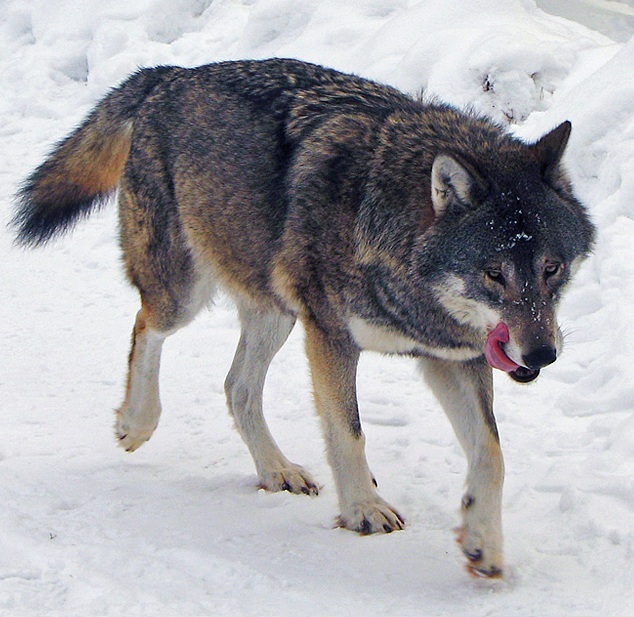
Thanks to the federal government's budget wrangling, the federal program that helps farmers and ranchers remove problematic gray wolves (also known as timber wolves) has been cut. (See the full story in the Star Tribune.)

I grew up in gray wolf country and, believe me, it's not like the program was being underutilized. Wolf attacks on livestock and pets are more of a problem now than they've ever been. My dad still has a beef cow-calf operation on my home farm and every year cows and calves are lost to wolves.


I vividly remember one night during our first spring farming up north. I had just finished the late calf feeding (we were milking the cows and feeding the calves three times a day then). It was a black, moonless night; only the yellow glow from the yard light kept the darkness at bay.

I was standing by the calf hutches when the wolves started. First, one wolf calling out. Then, the rest of the pack answering. If you've never heard a pack of wolves communicating, you can't imagine the involuntary tingles that run up your spine after the yips and howls register in your brain.

After the tingles, the fear and the worry set in. I had twenty-some baby heifer calves outside and more cows ready to calve in the pasture. And I was legitimately concerned about their safety. We had a dog on the farm, but that was no longer much consolation. When I was a kid, a farm dog was enough to keep the wolves away; but that wasn't the case anymore. In recent years, we'd had wolves within 100 yards of the barn. The yard light would help, but it was no guarantee.

The federal wolf-control program – the one that was cut – at least gave us some recourse when wolves caused problems. A phone call to Bill, our federal trapper (whose number was written right next to the phone in the kitchen) might not always result in the removal of the culprits, but at least we felt like we were doing something. If we were lucky, the wolves would still be around when Bill came and they'd be removed, like this one.


This wolf, a yearling who Bill said had likely just left his mother, and another yearling wolf were trapped after several attacks on my father's beef herd during the same spring I mentioned above. I don't like posting ugly photos, but I've been saving this photo for an opportunity like this. The photos we normally see of gray wolves, like the one at the top of this post, are of beautiful, healthy animals. In reality, most wolves in the wild have some degree of mange, like this one did, and they don't look nearly as picturesque as most photos depict them.

Nor are they as well-fed as the wolves normally photographed. And, as the wolf population continues to grow, so will the number of hungry wolves. Hungry wolves who can't find anything else to eat prey on farm animals and pets.

Without the federal wolf-control program, there will be no legal recourse for the farmers and ranchers for which wolf depredation is a challenge.