Wednesday, November 6, 2013

How Dairy Farmers Carve Pumpkins

Halloween is over. The rest of our country is now decorating Christmas trees and tackling holiday shopping. (It seems that Thanksgiving has once again been overlooked.)

But I still have a skeleton hanging on my patio and a jack-o-lantern sitting on the porch. There are still some Halloween cookies in the container on the counter. And, thank heavens, the kids' collection of candy from trick-or-treating hasn't been polished off yet . So it's not too late to write about all the fun we had with Halloween this year.


About that jack-o-lantern...

I'll let you in on a little secret: There is nothing about carving pumpkins that appeals to me. Well, the carving part isn't so bad. It's cleaning the pumpkin out that makes me gag.

But, from the way my kids talk, carving pumpkins into jack-o-lanterns ranks right up there with Santa Claus coming. So, for my kids' sake, I steeled my stomach and we managed to get one of our pumpkins carved after chores one night.

During chores that night, as I was dreading the upcoming carving, I had an idea. An ingenious way, if you ask me, to make pumpkin cleaning much more tolerable: an AI glove.


The kids thought that using a glove was hilarious and, of course, insisted upon using the glove to help.


The glove worked really well. And so did the canning lid I used to scrape the pumpkin guts off the shell. Next year, maybe we'll get all three pumpkins carved.

About the cookies and the candy...

My favorite part of Halloween this year was baking Halloween cookies and decorating them with our friends.

I stayed up late one night to roll and cut sugar cookies... by myself. I love baking and I love my kids, but, sometimes, baking with kids can be tricky. Baking by myself is a treat. A quiet, peaceful treat.


I also tried a new recipe for chewy chocolate cookies that the kids could frost and decorate with candy.

Cookie decorating with five kids was a little bit crazy and a lot of fun. So fun that I didn't manage to take any pictures during the decorating. But I did get one of the finished cookies.


And, we really didn't need any more sweets in the house, but I took the kids trick-or-treating anyway.


My little dragons and ladybug and I hope you had a fun Halloween, too.

Wednesday, October 30, 2013

The Equation

aka How to Calculate a Cow Owner's Share of Milk Income 

Last year at Midwest Dairy Expo, Glen and I shared our experiences as beginning farmers as part of a producer panel. One of the questions we were asked was how we calculated our milk check while we were working on another farm as herdsmen and housing our milk cows there. I'll explain everything below, but here's The Equation that Glen came up with:


number of cows
x  average daily milk production in pounds
x  days in month
x  milk price (per pound)
x  farm's net farm income ratio
x  cow owner's percentage of income
= cow owner's share of milk income


Before I explain how we ended up using this equation and give an example, let me share a few assumptions and requirements for this equation to work.

This equation can be used in a situation where the Cow Owner(s) own the cows, but someone else (the Farm) provides housing, feed, veterinary care, breeding expenses, labor, etc. Cow Owner(s) might be farm employees who own cows, like we did, but Cow Owners do not necessarily need to work on the Farm. Milk from the Cow Owner's cows is commingled with milk from the Farm's cows in one bulk tank. This equation is set up for a once-monthly payment from the Farm to the Cow Owner.

To use this equation, you need to know the cows' average milk production for the month. We used the production information from our monthly DHIA (Dairy Herd Improvement Association) test. We kept our cows in a separate string, which allowed us to easily determine average production.

For milk price, we used the Farm's mailbox price, which, of course, isn't available until the milk check for that month comes. (For example, we were paid in mid-January for the milk our cows produced during the month of December.)

You also need to know the Farm's net farm income ratio. The net farm income ratio, which is a measure of the Farm's financial efficiency, is the percent of the gross farm income that remains after all expenses are paid. The farm where we housed our cows was enrolled in the Minnesota Farm Business Management program, so we pulled their net farm income ratio off the executive summary of their financial analysis. We included this ratio in The Equation to make sure the Farm was compensated for feeding, housing, and otherwise providing for our cows.

The Cow Owner's percentage of income is a percentage that's mutually agreed upon between the Farm and the Cow Owner. We used 66%, which meant that we received two-thirds of the income from milk our cows produced and the farm kept the other third. This figure wouldn't necessarily need to be included in The Equation, but we added it so that our situation would be a win-win for both us and the farm we were working on. Adding our cows to the farm meant longer milking times and rearranging some fencing. In other situations, employee-owned cows might be occupying stalls that could otherwise house farm-owned cows. If the cows being housed on the Farm are owned by multiple owners, this percentage could be divided accordingly.

Here's how we ended up needing The Equation:

Back in 2006, we were milking cows on my dad's farm. We had just purchased the cows from him, but were still renting the facilities. Jane Salzl needed a herdsman for one year for the dairy farm she owned with her husband Sam. Sam had been badly injured in an accident earlier that year and was still recovering. Jane called us on July 29 and asked if we would be interested in the herdsman position. (Glen and I had done relief milking for Sam and Jane before we started farming.)

After considering Jane's question, we said yes, but with one condition – only if we could bring our cows along. As most dairy farmers and cow owners understand, we were attached to our cows. And we knew that after our year of working for Jane and Sam, we planned to find a farm in Stearns County and return to dairy farming on our own.

Jane and Sam decided that they could make room for our cows in their dry cow pasture, so we brought three-quarters of our small herd along with us. (Glen's dad and brother milked and housed the rest of our milk cows, along with our older calves.) We brought our bottle calves along to Jane and Sam's. We left our yearling heifers at my dad's.

During the four weeks between Jane's first call and the day we moved, one of the things we needed to figure out was how we would get paid for the milk our cows produced while they were at Sam and Jane's. One night during milking, Glen came up with The Equation as a solution. When we presented the idea to Jane and Sam, they agreed that The Equation would work.

Finally, here's an example of how we used The Equation:

In December of 2006, we had 32 cows milking at Sam and Jane's. On test day, they averaged 77 pounds of milk. Sam and Jane's milk price for December was $14.81/cwt. Sam and Jane's net farm income ratio was 37% (based on their financial analysis from 2005). As mentioned above, we used 66% for our share of income from our cows' milk.

So, plugging those numbers into The Equation...

32 cows  x  77 lbs.  x  31 days  x  $0.1481  x  .37  x  .66 = $2,762.51

We used this money to make our equipment and cattle loan payments while we worked for Sam and Jane.


If you have any questions, please feel free to contact us.


Monday, October 14, 2013

The salamander's great escape

What are little boys made of?
Frogs and snails and puppy dogs' tails,
That's what little boys are made of.


This bit of the little poem about boys and girls should have included a line about salamanders. At least, that's what I've decided after observing how much Dan loves the slippery, slimy, wiggly little creepers.

Each summer, Dan waits and waits for salamander season. When is salamander season? Salamander season is that time of year in the fall when, all of sudden, there are salamanders everywhere.

When salamander season starts, we find salamanders in the gutters in the barn (not a good place for them). We find salamanders hanging out on the sidewalk to the house. We find salamanders creeping through the grass on the lawn.


black and yellow spotted salamander


And when salamanders are found, they're captured. Most of the time, the captive salamanders are kept in a pail, with a little bit of water in the bottom. We let the kids keep the salamanders overnight and then they have to let them go. Sometimes, captured salamanders end up elsewhere – like in the refrigerator.

So, it should come as no surprise that we had a salamander in a pail in our front porch a couple of weeks ago. I found the salamander on the sidewalk and gave it to Dan. He asked for a pail to keep it in, so I got him an ice cream pail from the house.

When the kids came in for dinner, the salamander came with them – right into the kitchen. I turned Dan around and told him the salamander had to stay in the entryway. So, he set the salamander's pail in the corner by the doorway.

After dinner, we all went back outside to do evening chores. When we got back to the house after chores, Dan went to get the salamander. I was just coming through the door, when I heard him exclaim, "Where's my salamander?"

"What?" I automatically asked, hoping I hadn't heard him correctly.

"My salamander is gone," Dan said.

I looked in the pail. The water was still there. But there was no salamander.

Great. There's a salamander loose in our house.

I told the kids we'd look for it after we changed out of our barn clothes.

Glen just laughed and said, "You realize you're trying to find a creature that makes its living by being a master of disguise."

While we changed, I told the kids that salamanders like dark, damp places. They decided they should search the bathroom first.

By the time I changed my clothes and had undressed Daphne, Monika was squealing that she saw the salamander.

"It's in the office," she shrieked. "I saw it's tail go under the door."

I rushed to the office. It took a couple seconds after I opened the door, but I soon spotted the salamander crawling toward the desk.

Except it didn't look like a salamander. It looked like a salamander in a dust bunny costume. Which was seriously discouraging, since I've been deep cleaning like a mad-woman since school started.

No, I didn't take a picture. I whisked the dust bunny-salamander to the sink and rinsed him off under the hard water faucet. Dan had fetched the salamander's pail, so I set him back in it.

Then I told Dan that he had to say good night to the salamander and let him go outside. He protested until I explained that if the salamander managed to escape from the pail once, he could probably do it again.

"But, how did he get out?" Dan asked.

"I have no idea," I said. "Maybe he climbed out."

"We should have put him in a milk house pail (aka a five gallon pail)," Dan said.

"Yes, we should have. No more salamanders in ice cream pails."

I should probably extend that to no more salamanders – or other critters – in the house, but I know better than to put unrealistic limits on a little boy who loves creatures, especially the slippery, slimy, wiggly ones.


Monday, September 30, 2013

MooChews – Amazing Dog Toys Made From Upcycled Inflations

Note: Since this post was published, MooChews has changed its name to MooTugs. The name was changed to clear up confusion about the nature of the toys. MooChews/MooTugs are tug-of-war toys, not chew toys. Their new website is www.mootugs.com. (April 2014)


We dairy farmers use inflations for harvesting milk.

cow being milked with milking machine

For you non-farmers, inflations are the rubber tubes that attach to cows' teats when the cow is being milked. Milk from the udder flows through the inflations, into the milking machine (pictured above) and then to the pipeline and bulk tank. Below is what an inflation looks like when it's not installed in a milking machine.

rubber inflation from milking machine

Because inflations must always be in excellent condition, both for the cows' well-being and to ensure food safety, each set of four inflations is used for only a short time before being replaced with a new set. Exactly how long each inflation is used varies with each farm, depending upon how many cows are milked, how many milking machines are used and how the milking machines are cleaned after each milking. On our farm, inflations are changed every three months.

So, what happens to all those used inflations?

Well, if you're one of our kids, you turn them into hoops...

farm girl making hoop from inflations

And necklaces...

farm girl wearing necklace made from inflations

And trains...

farm boy connecting inflations

And snakes.

farm boy making snake with inflations

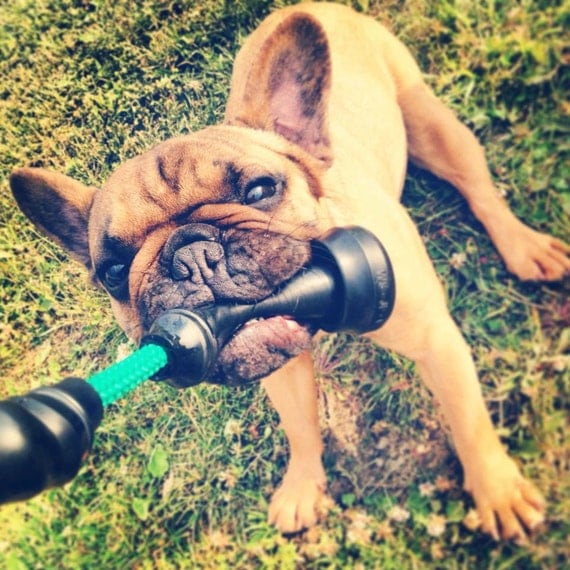
But, if you're Dan and Cristen Breuer, the ingenious creators of MooChews, you upcycle those used inflations into dog toys, like the one below.

MooChews MooTug dog toy made from upcycled inflations

Even Ozzy thinks it's the most brilliant idea for a dog toy (but wouldn't smile for the camera).

Australian Shepherd farm dog with MooChews MooTug

I first learned about MooChews this spring when Cristen contacted us to ask if we'd be willing to donate our used inflations to MooChews. Of course, since I'm unconditionally obsessed with recycling, I agreed. On most dairy farms, used inflations have no purpose so they are discarded; prior to Cristen's request, ours were thrown away, too.

Now, Cristen and Dan come out to our farm every couple weeks to pick up our used inflations and the used inflations from several other farms. Our milking equipment company collects used inflations from its clients' farms and drops them off here. Dan and Cristen also get inflations from Cristen's family's dairy farm in Colorado and a couple other Minnesota dairy farms.

Before Dan and Cristen turn the inflations into their tug-of-war and fetch toys, they soak, scrub and sanitize the inflations in their home. But even after all that cleaning, the inflations still smell a little bit like dairy farms, which, according to Cristen, makes the MooChews toys irresistible to dogs.

French Bulldog with MooChews MooChucks dog toy
Photo used with permission from MooChews

You can read the whole story behind the invention of these clever dog toys – and the company's contributions to dog rescue charities – by visiting the MooChews website or checking them out on Etsy and Facebook.

And, if you'd like one of the great MooChews toys for the canine in your life, you can get free shipping by entering the code BDDAIRY1 at checkout.

Monday, September 16, 2013

To be a calmer, happier mom

Shortly after we started milking one morning a week or so ago, Glen turned and said to me: "Why do you look so tired?"

"Well," I told him, "I stayed up to finish my blog post and then the night turned into a game of musical mattresses."

After I finished my blog post, I slipped into bed with Glen, who was sleeping on the mattress in the living room because the sheets for our bed were still in the wash.

But as I laid there trying to slow my mind down, I couldn't stop thinking about how poorly bedtime with Dan and Monika had gone. Bedtime had been a disaster. Dan wouldn't do what I asked. I lost my temper and yelled. Dan and Monika cried. I left them upstairs crying while I went downstairs to cool off. They eventually fell asleep.

But I felt terrible. Guilty. Bedtime is supposed to be a peaceful transition from day to sleep. A chance for us to read a book and pray together, for me to sing to them and rub their backs. It's not supposed to be a fight.

So, I crawled out of bed and tiptoed upstairs to Dan and Monika's room. I sat down on the bed between them and watched them in the blue glow of the night light. Their beautiful faces looked so peaceful as they slept.


I smoothed Monika's hair and rested my hand on Dan's cheek. And I thought to myself:

How can these little people, who I love more than life itself, make me so frustrated, even angry, at times?

I whispered into their sleeping ears: "I love you so much and I'm so sorry."

As I sat there, unresolved guilt bubbled up in my heart. Guilt from a question Monika asked a few weeks ago.

I was sitting on the floor in the living room with Daphne. I had just finished changing her diaper and she was now standing up between my bent knees. She was grinning from ear to ear and I was smiling back at her.


Monika was sitting right next to us.

"Momma, how come you're only happy at Daphne?"

My heart stopped for a second. Time stopped. I sat there reeling as my four-year-old's innocent, honest words hit me like a fist in the gut.

Monika was right. I do smile at Daphne a lot. When Daphne beams her big smile at me and coos, it makes my whole being happy, and that shows on my face.

But am I only happy at Daphne? Do I smile that much more at Daphne than I smile at Dan and Monika? So much more that it's noticeable?

Apparently, or Monika wouldn't have asked. But, why?

The explanation I tried to give Monika only half-answered her question:

"Well, honey," I said, "maybe because Daphne doesn't whine and misbehave."

What I didn't tell Monika was that maybe if I didn't spend 86% of my time with her and Dan on refereeing and redirecting and keeping them on task, I would have more time to smile.

I also didn't tell her that I felt awful. How horrible, that my little girl would think that only her baby sister makes her momma happy.

Even though I did my best to make us all smile that morning by giving Dan and Monika airplane rides on my feet, Monika's words still hung in my head.

I kissed Dan and Monika on the cheek and tiptoed out of their room. I wrapped myself up in a quilt and tried to fall asleep in my own bed.

Just as I was starting to relax enough to fall asleep, I heard Daphne start to fuss. So, I crawled out of bed and went to lay with her.

Before I finally drifted off to sleep, with Daphne cuddled up next to me, I resolved to be a calmer, happier mom.

A few days later, this quote showed up in one of my parenting magazines*:


           "Emotions are contagious
in families, and moms are the
                               emotional centerpiece."


I cut it out and put it up on the fridge.

Seeing these words on paper every day helps me remember that if I remain calm and happy, instead of losing my cool – whether it's over bedtime or supper or homework – everyone else will stay calm(er) and happy(er), too.

I'm also trying to smile more at all of my beautiful children.


*This quote was from the 5 most stressful moments in your week by Mindy Walker, published in the September 2013 issue of Parents.